ONE:She listened attentively to the account of the traces of a struggle among the willows, and asked who had fired the shot. It was not known, they said, and the sullen buck would probably never tell.¡°Huh!¡ªuh¡ªoh!¡±
ONE:During the summer a French squadron stretched away across the Atlantic with six sail of the line, and finding our Newfoundland coasts almost wholly unprotected, destroyed and plundered the fishermen's huts and fishing stages, as well as their vessels, and then, returning, picked up a considerable number of our merchantmen at sea, and was lucky enough to make a retreat, by favour of a fog, through our watching squadrons, into Brest. After this clever exploit, they joined the great Brest fleet, which sailed for Ireland on the 15th of December. This consisted of no fewer than forty-three sail, seventeen of them of the line, four frigates, six corvettes and brigs, with six transports. On board the transports were twenty-five thousand men, who had been well tried in the war of La Vend¨¦e, and abundance of arms and ammunition, as well as extra arms to put into the hands of the disaffected Irish, for to Ireland the armament was bound. General Hoche, who had terminated the Vend¨¦an war, was appointed to terminate all the woes of Ireland, and convert that sacred island into another French paradise. Besides Hoche, Generals Grouchy, Hombert, and Bruix were attached to the expedition. The fleet sailed out and anchored in Camaret Bay, but no British fleet was visible to intercept them. But no sooner did the armament put out to sea again the next day, than it was assailed by a tempest and the ships were driven different ways. One of them was forced immediately on the Grand Stenet rock, and wrecked¡ªout of one thousand four hundred souls on board only sixty were rescued. Seven ships of the line, and ten of the vessels commanded by Rear-Admiral Bouvet, managed to reach Bantry Bay on the 24th of December, but there the storms continued to batter them. There being no sign of an insurrection, and no other part of the fleet appearing, they sailed back and reached Brest on the 1st of January, 1797. When they were gone, another portion of the fleet arrived in Bantry Bay, but only to be tossed and driven about without rest, to lose several of the ships, and to put back again. As for Hoche, he never saw Ireland; the greater part of the fleet being driven about and swamped in the Channel. Of the forty-three sail, only thirty-one returned, and thousands of the soldiers were drowned in the foundering transports. Sir Edward Pellew, in the Indefatigable, of forty-four guns, and Captain Reynolds, in the Amazon, of thirty-six guns, fell in with the Droits de l'Homme, of seventy-four guns, and after a severe fight close in Audierne Bay, south of Ushant, left her a wreck aground, where, of the one thousand eight hundred men aboard, scarcely more than three hundred were saved, notwithstanding the greatest exertions of the British seamen to rescue them.Defeated in this object, the Patriots united all their force to embroil us with Spain. There were many causes in our commercial relations with Spain which led to violent discontent amongst our merchants. They found the trade with the Spanish settlements in America exceedingly profitable, but they had no right, beyond a very limited extent, to trade there. The Spaniards, though they winked at many encroachments, repressed others which exceeded these with considerable vigour. Their Coastguard insisted on boarding and searching our vessels which intruded into their waters, to discover whether they were bringing merchandise or were prepared to carry away colonial produce. By the treaty of 1670 Spain had recognised the British colonies in North America, and England had agreed that her ships should not enter the ports of the Spanish colonies except from stress of weather, or with an especial licence from the Spanish Government to trade. By the treaty of 1729 we had agreed to the old regulations regarding trading to the Spanish Main, namely, that we should have the Assiento, or right of supplying these colonies with slaves, and that, besides this, we should only send one ship annually to the Spanish West Indies and South America. As fast as that authorised ship discharged its cargo in a Spanish port, she received fresh supplies of goods over her larboard side from other vessels which had followed in her wake, and thus poured unlimited quantities of English goods into the place. Other English traders did not approach too near the Spanish coasts, but were met in certain latitudes by South American smugglers, who there received their goods and carried them into port. In short, such a system of contraband trade was carried on in these waters by our merchants, that English goods in abundance found their way all over the Spanish American regions, and the great annual fair for goods imported from or by Spain dwindled into insignificance.
TWO:This was followed by a memorial, signed by most of the chief officers, including Lord George Murray, Lochiel, Keppoch, Clanranald, and Simon Fraser, Master of Lovat. This was sent by Lord George to Charles, and represented that so many men were gone home, and more still going, in spite of all the endeavours of their chiefs, that if the siege were continued they saw nothing but absolute destruction to the whole army. The prince sent Sir Thomas Sheridan to remonstrate with the chiefs, but they would not give way, and Charles, it is said, sullenly acquiesced in the retreat.
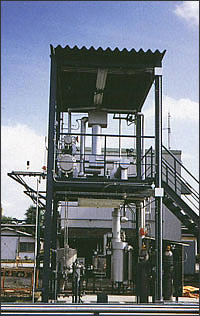
Great attention is recently being paid to global environmental issues, and it is now conceivable that companies will need to treat used solvents themselves. In consideration of this kind of social issue, we have developed a “membrane separation type solvent dehydration system,” which uses a polyimide membrane with superior dehydration properties developed by Ube Industries, Ltd. in combination with our own distillation and concentration technology that has resulted in solvents being more easily recovered.
THREE:In Italy nothing was done till late in the year. Towards the end of November, the French army, under Massena, commenced operations in earnest. The Austrians and Piedmontese being scattered over a wide extent of country, defending various passes, the French attacked and beat them from different points. The right and centre of the Allies were ere long routed; and the left, posted on the shores of the bay St. Pier d'Arena, near Genoa, was attacked, both from the land and from the water, by gunboats, which Nelson, who had been detached to co-operate with the Austrians, had no means of coping with, except by letting loose a far greater number of armed vessels, and was also compelled to flight. Nelson managed to keep open the Bochetta pass for them, or from eight thousand to ten thousand prisoners would have been made, including the Austrian General Devins himself, who was laid up at Novi, at the foot of the Apennines. The French were then in a position to open the campaign against Italy in the spring.
1Under the distillation system, even in case of azeotropic solvent compositions, this system which remove water vapor by the polyimide membrane will easily dehydrate.
2In comparison with the distillation system, it significantly saves on use of steam.
3Dehydration can be performed through merely supplying evaporated vapor to the membrane module and maintaining the differential pressure between the permeable side and the impermeable side.
4Solvent purity of 99.9% or more can be achieved by carrying out dehydration with a polyimide membrane only.
5The polyimide membrane has superior heat and solvent resistance. Therefore, the vapor permeation system reduces contamination of the membrane and thus extends its life.
THREE:
The aromatic polyimide membrane is highly permeable to water vapor but less permeable to vapors of organic compounds such as alcohol etc.
THREE:137Mackintosh, who was a young lawyer of excellent education, but yet entirely unknown, this year published his "Vindici? Gallic?," in reply to Burke; but he did it with the behaviour of a gentleman, and evident admiration of the genius and political services of the great man whom he opposed. His book was immensely admired, and at once lifted him into notice. But it was not long before he began to see the correctness of Burke's views and prophecies as to the French Revolution, and he did not shrink from avowing the change of his sentiments in the Monthly Review and in conversation. His talents and this alteration of his views recommended him to the Ministers, and he was appointed by Pitt and Loughborough a professor of Lincoln's Inn, where, in a course of lectures on the Constitution of England, he exhibited himself as an uncompromising censor of the doctrines he had approved in his "Vindici? Gallic?." For this he was classed, by the vehement worshippers of French ideas, with Burke, as a venal turncoat. Mackintosh did not content himself with recanting his opinions on this topic from the platform and the press; he wrote directly to Burke, who was now fast sinking under his labours and his disappointments, and expressed his undisguised admiration of his sagacity as a politician, and of his general principles and political philosophy. Burke invited him down to Beaconsfield, where a closer view of the philosopher and orator greatly increased his esteem and admiration of the man.
1 Recovery of the detergent solvent Recovery of the cleaning solvent such as electronic parts industry, precision instrument industry.
2Solvent recovery and the refinement Solvent recovery and the refinement such as chemical industry, an industry of medical supplies, food industry, the fermentation industry.
THREE:¡°Long Distance Operator, please,¡± he spoke into the transmitter.Whilst these contentions were going on, Wren had entered fairly on his profession of architect. He built the Sheldonian Theatre at Oxford, begun in 1663, and completed in 1669; and the fine library of Trinity College, Cambridge, and the beautiful square, Neville's Court, to the same college. He also built the chapels of Pembroke and Emmanuel Colleges, in the same university. In the erection of these, he suffered, from the conceit and conflicting opinions of parties concerned, a foretaste of the squabbles and contradictions which rendered the whole period of the building of St. Paul's miserable. In 1665 he found leisure to visit Paris, and study the magnificent palaces and churches with which Louis XIV. was embellishing his capital. There he got a glimpse of the design for the Louvre, which Bernini, the architect, showed him, but only for a moment; and he was in communication with Mansard, Le Vau, and Le Pautre.